
Maria is shopping for a new mattress. She sees an Instagram ad from a store in Agia Paraskevi, an Athens suburb, searches for reviews on Google that evening, and the next day visits the site on her phone, but she can’t find anywhere when delivery happens and closes the page. Two weeks later she buys from another store. That path, with all its stops and obstacles, is the customer journey, and a business that understands it wins customers it would otherwise lose without ever realizing it.
Most business owners only see the last step, the sale or the loss. Everything in between stays invisible. In this guide we explain what the customer journey is, which stages it includes, how to build your first map without expensive tools and which improvements usually have the biggest impact.
At a glance
- The customer journey describes a customer’s entire experience with your business, from first contact to recommending you to friends.
- The path is rarely straight: customers move back and forth between channels and devices.
- A simple map reveals where customers get stuck and where you are losing sales.
- The most effective improvements are often small: a missing piece of information, one less step at checkout, an email at the right moment.
What the customer journey is and why it isn’t a straight line
The term refers to the sum of experiences someone has with your business: what they see, think, feel and do, from the moment they first come across you until long after the purchase. It is not limited to your site or your store; it includes ads, reviews, phone calls, packaging and after-sales service.
The classic “sales funnel” presents the process as a downhill slope in a fixed order. In reality it is more like a stroll through a department store: the customer comes in through one door, leaves, returns through another entrance, asks a friend, compares prices on their phone. Two customers of the same business can follow completely different paths to reach the same result.
The five stages of the customer journey
Despite the variations, most journeys go through five phases. Let’s look at them through the example of a dental clinic in Glyfada:
| Stage | What the customer is thinking | What they need from you |
|---|---|---|
| Awareness | “I have a toothache, I need to find a dentist near me.” | To find you: local search, a maps profile, recommendations |
| Consideration | “Who is trustworthy? What do other patients say?” | Reviews, clear information about treatments, photos of the practice |
| Decision | “Can I book an appointment quickly and easily?” | Simple booking, a visible phone number, a prompt reply |
| Retention | “Was I satisfied? Will I come back?” | A good experience, reminders, aftercare |
| Advocacy | “I’d recommend them to friends.” | A chance to leave a review, a reason to talk about you |
The last stage is often forgotten, yet a satisfied customer who talks about you starts someone else’s journey. We explain how to strengthen this phase in our article on user-generated content.
Where do customers encounter your business?
Every moment of contact with your brand, digital or physical, is called a touchpoint. It helps to group them by when they happen:
- Before the purchase: search results, ads on Google and social media, posts, reviews, word-of-mouth recommendations, articles on your blog.
- During the purchase: product and service pages, landing pages, cart and checkout, phone, chat, a visit to the physical store.
- After the purchase: confirmation email, shipping updates, packaging, invoice, customer service, newsletters, loyalty programs.
Today most touchpoints run through mobile. If your website is hard to use on a small screen, the journey is cut short before it even begins; that is why our guide to the mobile-friendly website is also worth a read.
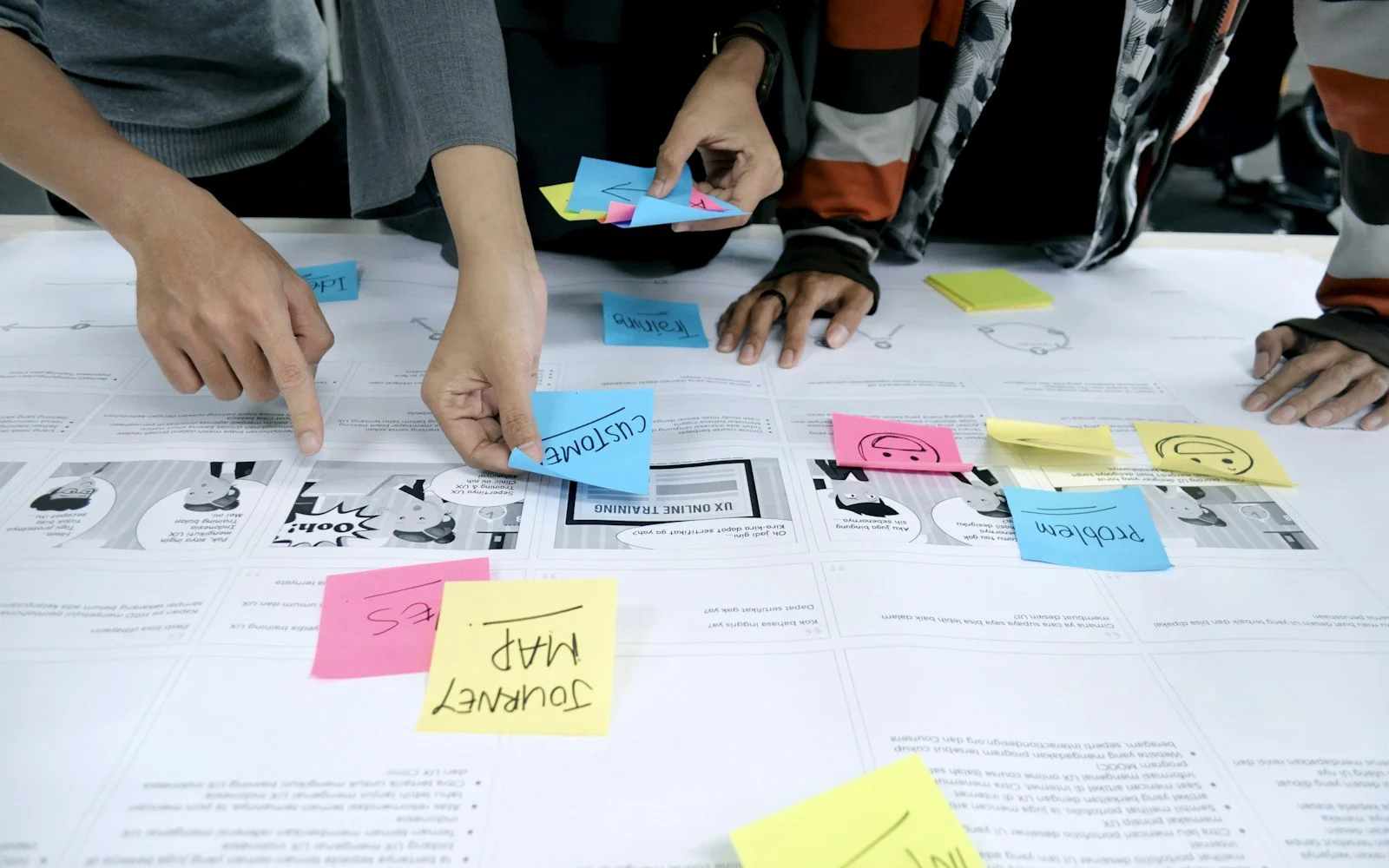
How to build your first customer journey map
You don’t need specialized software. A whiteboard, sticky notes or a simple spreadsheet is enough to get started.
1. Get to know your real customers
Combine numbers (traffic statistics, sales history) with conversation: ask a few customers how they found you and what made them decide. From there, sketch out two or three profiles, for example “the new mom who shops on her phone at night” and “the professional who needs an invoice and fast delivery.”
2. List every touchpoint
For each profile, note where, when and how they come into contact with you. Don’t forget the “silent” touchpoints, such as your voicemail greeting or the automatic email after an order.
3. Walk the journey yourself
Make a test purchase on your phone, send a question through the form, call outside business hours. You will be surprised by how many small obstacles are invisible from the business side.
4. Note thoughts, feelings and obstacles
At each stage, write down what the customer wants to know, what worries them and what might make them leave. This is where you find the “pain points,” such as a shipping cost that only appears at the very last step.
5. Set priorities
You can’t fix everything at once. Start with the obstacles that affect the most customers and cost the least to solve.
6. Measure and revisit the map
Set metrics for each change, such as cart abandonment rate or form inquiries, and review the map every few months. Customers change their habits, and the map has to keep up with them.
Improvements that make the biggest difference
- Content that answers real questions. Pages and articles that resolve the questions of the consideration phase bring you search traffic and build trust. You will find the core principles in our guide to SEO.
- Friction-free navigation. Clear menus, prominent buttons, fast loading and a checkout with as few fields as possible.
- Consistency across all channels. The same prices, the same tone and the same information on your site, social media, email and in your physical store. Contradictions breed suspicion.
- Automations at the right moment. An abandoned cart reminder, a welcome email, a feedback request after delivery. See how to set them up in our article on email marketing.
- Continuous measurement. Analytics show where visitors leave; A/B tests show which solution works best.
Customers don’t remember your company’s departments. They remember whether the overall experience was easy or exhausting.
Mistakes that make the map useless
- Designing it around how you would like customers to behave rather than how they actually behave.
- Focusing only on the sale and ignoring everything that happens afterward.
- Having only the marketing department create it, without input from the people who talk to customers every day.
- Locking it away in a drawer instead of using it to make decisions.
How FoxWeb can help
At FoxWeb we look at every project through your customer’s eyes. We combine data, user experience and communication so that each touchpoint leads smoothly to the next.
Journey analysis
Using analytics and testing, we pinpoint where visitors drop off and what stops them.
Websites that lead to a decision
We design websites and e-shops with a clear structure, fast loading and a simple checkout.
Post-purchase communication
We set up newsletters and automations that keep customers close to you.
Frequently asked questions
What is the difference between a customer journey and a sales funnel?
The funnel describes the stages from the business’s point of view and presents them in a linear way. The customer journey looks at the experience from the customer’s point of view, with all its backtracking, detours and emotions, and it continues after the purchase.
Does a small business need a customer journey map?
Yes, and in fact it can build one more easily than a large company. A few hours of conversation, a test purchase and a simple table are enough to reveal the first obstacles.
How often should the map be updated?
It is a good idea to revisit it at least once or twice a year, and also whenever something significant changes: a new site, a new sales channel, a new customer segment.
Which tools help with mapping?
Website analytics, reports from ad platforms, satisfaction surveys and customer service notes provide the raw material. For the visual itself, even a spreadsheet will do.
Conclusion
Maria, in our example, didn’t leave because she disliked the mattress; she left because a piece of information was missing at the moment she needed it. That is the point of journey mapping: seeing the small obstacles that cost you big sales.
Start with a simple map for your most typical customer, fix the obvious issues first and measure the result. A well-studied customer journey is not a one-time project but a way of making decisions with the customer at the center.
Want to see where your own customers get stuck? Contact FoxWeb or call +30 210 300 57 57 for an initial analysis.